
Lennard James Cleveland Darbee (1911–1991) was born on April 14, 1911 in Idaho. He was born to parents Clevland Darbee Jr. and Constance Shaw Cleveland Darbee. He had one younger brother named Chester Edwin Samuel Darbee.
Lennard graduated from Stadium High School in Tacoma, Washington in 1928.
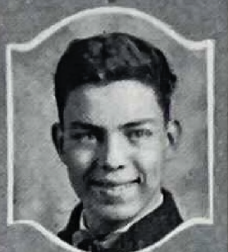
Lennard traveled to Texas and earned two degrees in three years at Baylor University. After college, he returned to the Seattle-area where he married and became a Baptist pastor. He would later travel the United States and the world as an evangelist in the late 1940s/early 1950s after transitioning into the Pentecostal/healing-revival world.
During most of his adult life, his family lived in a little home in Seattle on Fauntleroy Avenue.
He and his wife had two children, David and Marian. His first wife, Nancy Humfleet Darbee, died around 1969-1970.
Lennard’s second wife, Ruth Kirsten Lindgren Darbee, (January 1920 – October 1999),
The December 1943 Baptist Bulletin lists Galilee Baptist Church, Seattle — Rev. Lennard Darbee, with the address 6561 Fauntleroy Ave. The publication is associated with the General Association of Regular Baptist Churches, placing him squarely in conservative Baptist circles.
January 1948: A Klamath Falls, Oregon newspaper advertised Darbee conducting a “Glorious Gospel Crusade” at First Baptist Church. His sermon titles included “THERE IS NO HELL!”—apparently a provocative question rather than a declaration of universalism, since the advertisement immediately asks whether hell has been misunderstood, whether it means annihilation or is merely “age long,” and “What does God say?” Other subjects included “Where Was God When Bataan Fell?” and “How Long Can a Lost Man Live Without God?”
March 12, 1936: Lennard Darbee assisted in officiating the funeral for former head pastor of Gatewood Baptist Church Rev. Archibald Mackintosh. Lennard had become Gatewood’s head pastor sometime between 1930-1936. Gatewood was located at 44th Ave SW and W Othello Street in West Seattle.
May 1936: Lennard Darbee married Nancy Humfleet.
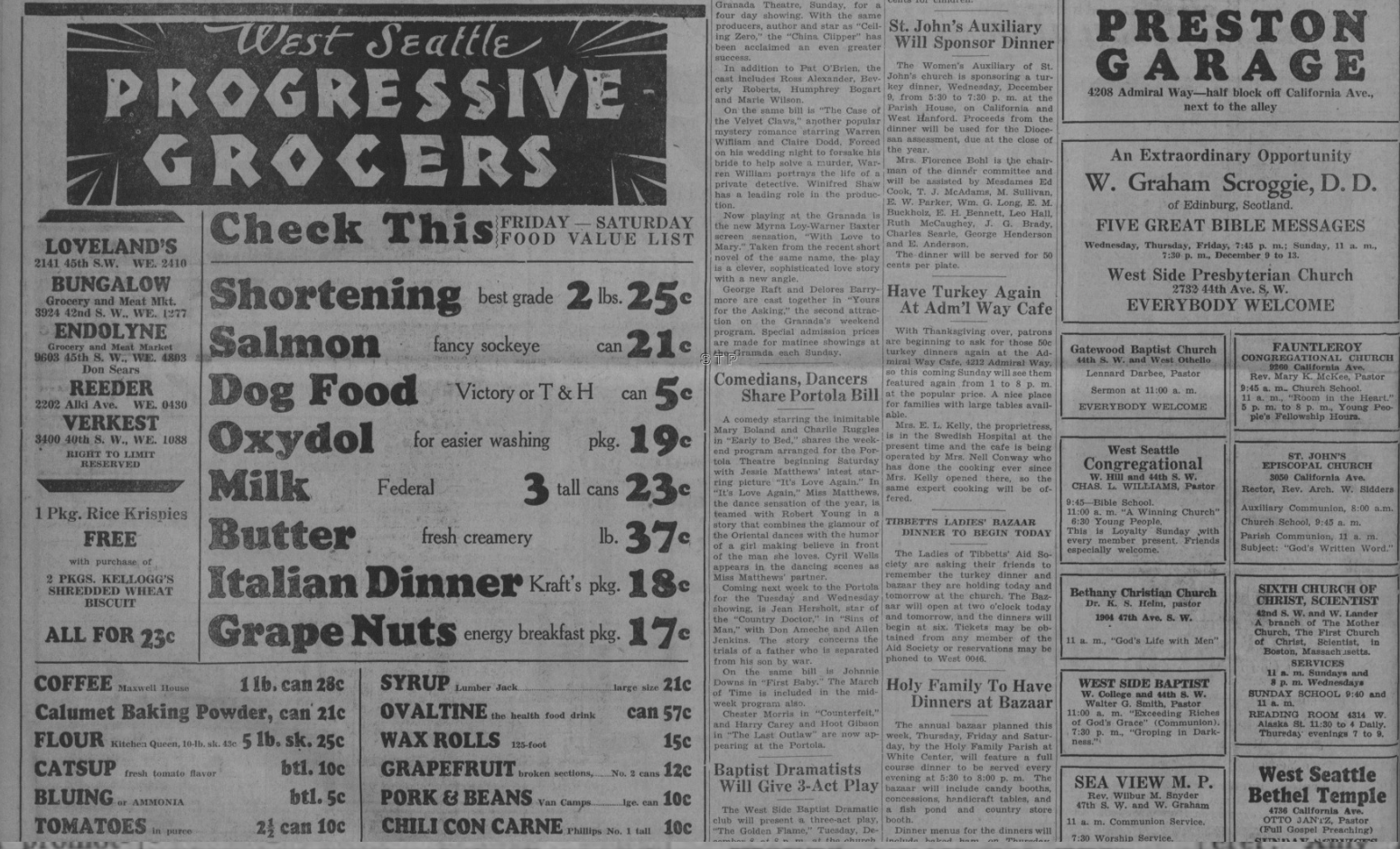
January 14, 1937: Lennard Darbee is advertised (West Seattle Herald) to speak on January 18th at the home of Mrs. Elizabeth Winn on the topic of “Man’s Search for God” to the West Seattle WCTU (Women’s Christian Temperance Union).
Late 1940s/early 1950s: He encountered the healing evangelist William Branham at the Tacoma ice arena. Darbee later described this as a watershed event in his ministry. In his own account, he had been a Baptist evangelist accustomed to biblical exposition but became convinced that contemporary Christianity ought to exhibit supernatural “signs, wonders, miracles.”
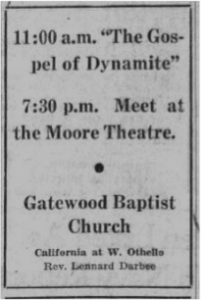
June 4, 1942: Lennard Darbee was advertised to speak on “The Gospel of Dynamite” for Gatewood Baptist Church, according to the West Seattle Herald.
1956: Darbee was unquestionably participating in the American healing-revival network. The September 1956 Voice of Healing advertised him alongside Jack Coe, W. V. Grant, Thea Jones, Alton Hayes, and Fred Pool at a camp meeting where the evangelists would preach and pray for the sick at every service.
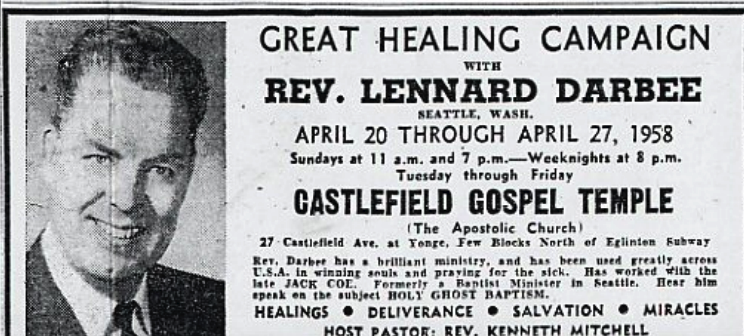
April 1958: Darbee was advertised (Toronto Telegram) in association with a healing campaign at Castlefield Gospel Temple in Toronto, Canada.
Later ministry: A missionary memoir places “a brother from Seattle, Lennard Darbee” teaching a Bible seminar in Huancayo, Peru, then traveling to Tarma for meetings. The account includes healing claims associated with those meetings. I have not yet established the date independently.
Lennard Darbee, husband, father, and minister of the gospel, is mostly widely known as a healing evangelist who traveled the country and various parts of the world preaching and healing the sick. The podcast episodes on this website were taken from his Seattle-based radio show, Rays of Faith, which aired from the 1960s to the 1980s.
His transition from Baptist fundamentalist to Pentecostal healing evangelist
Darbee himself wrote an article titled “A Baptist Scribe Hears a Pentecostal Prophet!”, published in the September 1956 issue of The Voice of Healing. It is essentially his conversion narrative—not conversion to Christianity, but conversion from Baptist cessationism/fundamentalism to belief in present-day supernatural gifts.
He says he attended a William Branham meeting in Tacoma as a “Baptist evangelist.” He describes what he believed were dramatic healings and manifestations and says the experience convinced him Branham was “a prophet of God.” From that point, Darbee began contrasting mere intellectual knowledge of Scripture with experiential knowledge of God’s supernatural power.
Lennard’s writing
His Baptist ministry had already been successful. After a Tacoma meeting he continued conducting campaigns around the country, had preached repeatedly at Moody Memorial Church in Chicago, and held large union tent meetings. Eleven of Lennard’s sermons were published in John R. Rice’s Christian newspaper, The Sword of the Lord, from 1946 – 1950. Yet he remained dissatisfied because, as he saw it, his ministry lacked the supernatural signs he had witnessed in Branham’s.
He is the author of two books. His most well known is Tongues: The Dynamite of God, a fifty six page treatise on speaking in tongues which included his own personal testimony. The booklet was self-published and referenced by several other authors, including Hugh Black’s The Clash of Tongues.
His second book has not been widely circulated, but a copy has been retained by Lennard’s family.
One description of Darbee and his book: “The author, a former Baptist, defends the Pentecostal movement from scripture and church history.”
The book argued specifically against cessationism. A later work quotes Darbee from pp. 26–27 arguing that the modern church does not literally kill prophets but instead ignores them, and that contempt for the gifts of the Spirit handicaps the church. He proceeds to argue that 1 Corinthians 12–14 cannot reasonably describe spiritual gifts at length only for Christians subsequently to disregard them.
He also tried to find charismatic phenomena within earlier evangelical history. For example, Tongues p. 24 recounts an anecdote attributed to R. A. Torrey in which D. L. Moody supposedly began speaking in another language while attempting to preach in London. Darbee used it as evidence that tongues were not confined to stereotypically Pentecostal churches.
Darbee’s central theological concern became the distinction between Christianity as words/doctrine alone and Christianity accompanied by the experiential power of the Holy Spirit. In the Branham article he repeatedly invokes 1 Corinthians 4:20—“the kingdom of God is not in word, but in power”—and argues that biblical Christianity should still have supernatural manifestations.
At the same time, he seems to have retained a good deal of his old conservative evangelical framework rather than becoming doctrinally loose. Surviving Rays of Faith programs cover subjects such as being born again, Christ’s deity, faith, evangelism, tithing, false gospels, the prosperity doctrine, and what he considered counterfeit Christianity. So “Pentecostalized fundamentalist” may actually describe his intellectual development better than simply “Pentecostal preacher.”
Known for his quote in The Sword of the Lord vol. 10, no. 46 (November 19, 1948), Lennard wrote, “If God does not soon do something drastic to America, He will have to apologize to Sodom and Gomorrah.” A similar quote was later attributed to Billy Graham’s wife, Ruth.
Lennard is survived by his daughter, Marian Dessinger and her husband Steven Dessinger, their two children Kristine and Daniel, and Daniel’s three children. He is also survived by his grandson Amos Darbee.
Lennard passed on May 7, 1991.